
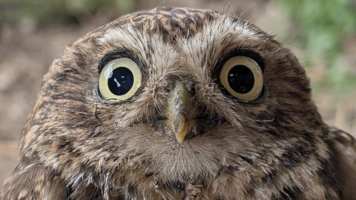
Welcome! This is the first of a new blog which we hope to publish monthly during the summer season, in order to keep our Friends and supporters up to date with our progress.
You may recall that 2025 was a terrible year for owls; we ringed just 10 Barn Owl chicks across the whole of Buckinghamshire. The Barn Owl Trust published their annual report, to which we contribute, in mid-March, and while there were some areas which had reasonable results, on the whole it was a bleak year across the board. Their headline quote was “A terrible year for Barn Owls with most areas seeing significantly fewer nests and small brood sizes.”
Against that background we had all been wondering what 2026 would bring.
Tawny Owls are the first of our regular box occupants to breed; they typically lay in March to April and have an incubation period of about 30 days, so there can be chicks in the nest from early April onwards. They are ringable ideally at about 12-15 days old, so April is a key month for monitoring and ringing.
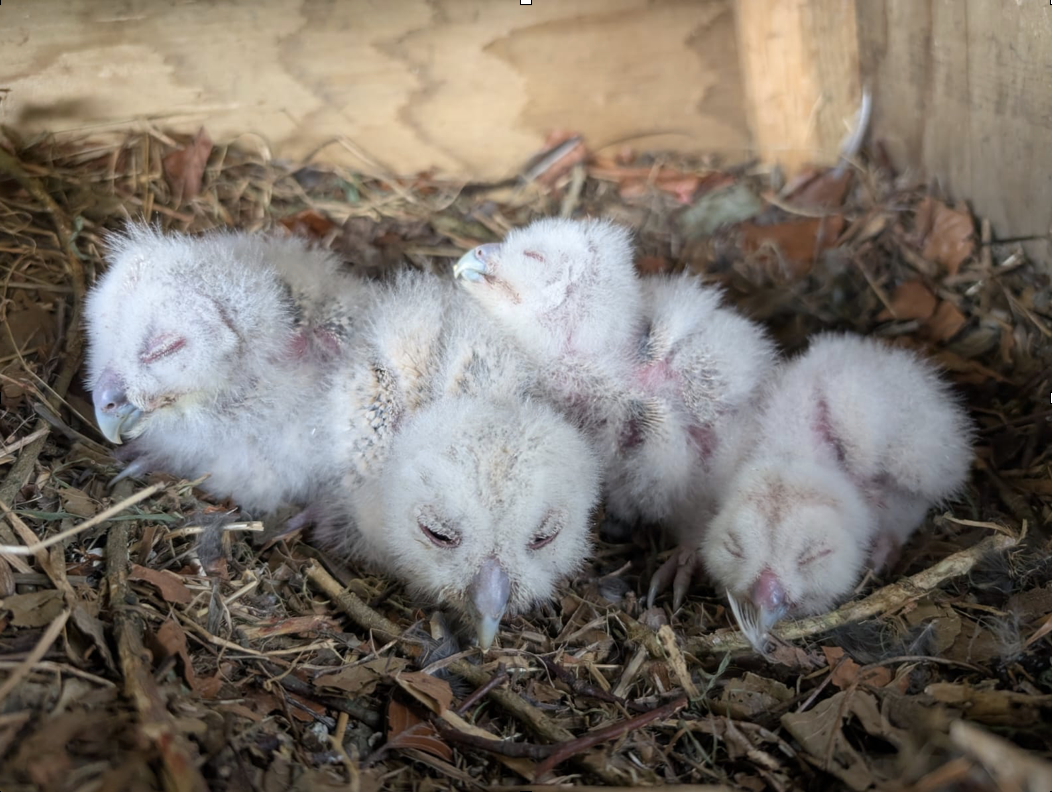
This year… Luke found our first Tawny on eggs while doing some pre-season box maintenance near the Oxfordshire border, surprisingly on 23 February! That must have been something of an outlier as the next sighting was in the Cholesbury area on 1 April, when Lynne found three Tawnies on eggs. Since then we have found another half-dozen clutches as eggs or chicks, most spectacularly perhaps four chicks with an adult which was itself ringed by Norman Shepherd as a chick in 2022.

Norman with Tawny chicks in 2022; one of those chicks as adult this year, and its own brood of four chicks.
We have noticed that the adult females seem more reluctant to leave the nest box on our approach this year; they are typically very sensitive to our approach (it is difficult being completely silent in woodland with fallen leaves and twigs all over the ground). We suspect this may be related to the relatively cold air temperature; they are perhaps sticking around to keep the chicks warm. We are taking this into account when ringing, by trying to keep the chicks protected (e.g. under a fleece) while they are out of the nest.
Barn Owls tend to lay their eggs a little later in the year, typically April to June, with a slightly longer incubation period, averaging about 32 days.
Luke saw our first pair of roosting Barn Owls while out on 23 February, one of which was ringed as a chick by Lynne, about 2 miles away, in 2024. We had seven visual sightings in March, as well as activity in camera boxes, and towards the end of the month Mark memorably assisted in the release of a wild Barn Owl which had been treated at the local wildlife hospital.
Our colleagues in the Bisham Barn Owl Group reported their first Barn Owl egg on 24 March. We had to wait until 2 April when Claire found a Barn Owl on 6 eggs at Oakley. We’ve also had another 7 sightings in and around our boxes, including re-trapping one individual previously ringed by Claire and Lynne in 2024.
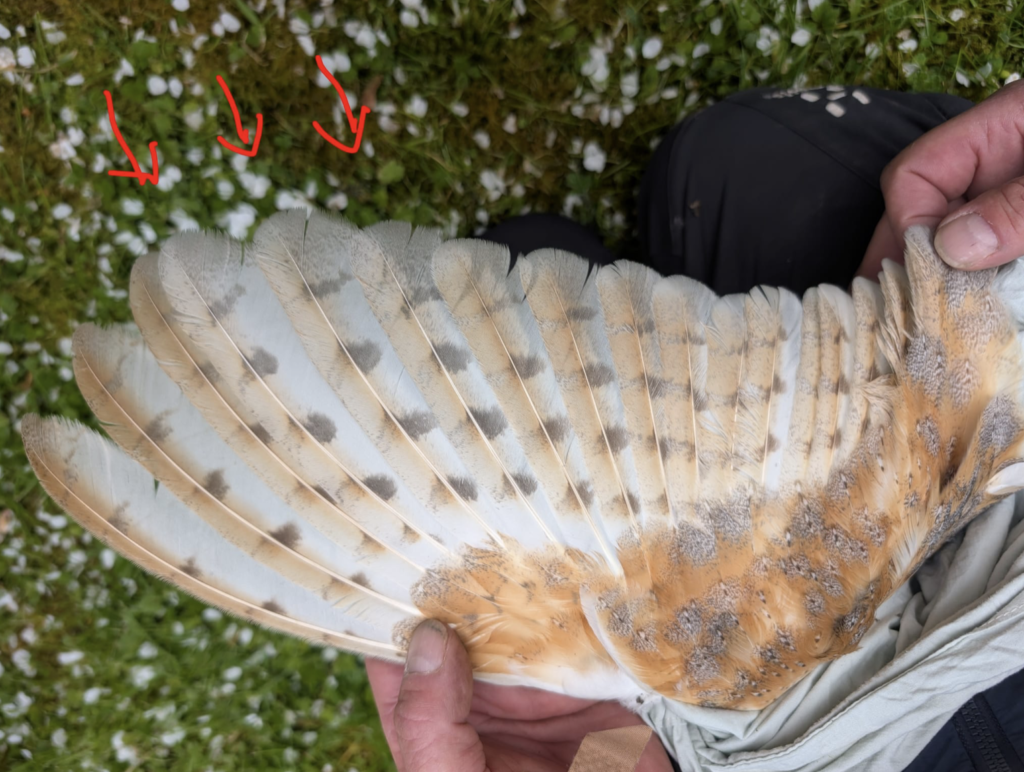
Wing of re-trapped adult Barn Owl showing three middle feathers replaced in last year’s moult.
Given that our focus at this stage of the season has been Tawnies, so we have monitored only a small fraction of the Barn Owl boxes across the county, it all feels very encouraging after the poor results last year.
To complete the round of the birds we target, we have so far found one Kestrel on a clutch of six eggs, and been treated to some terrific camera footage of a Little Owl ousting an inquisitive (or is that acquisitive) Grey Squirrel from within its box; sadly not our own footage so we can’t share it here. We have also (of course!) found plenty of evidence of Grey Squirrel, Jackdaw and Stock Dove using our boxes; we have already ringed three Stock Dove chicks from two different boxes within the first ten days of April.
It feels like a good start to the year and one which has put a lot of smiles on faces. Now we are all hoping those smiles can carry on through the rest of the breeding season and into the Summer.
Many thanks for the update. Not sure why 2025 was a bad year. We live near HS2 works and have noted the significant decline in tawny owls rarely heard them last year – and also the bats that used to fly around our garden. Is it to do with the loss of dark skies at night? Rabbits and squirrel numbers are rising. Do the latter attack owl nests?
Hi Linda and apologies for the slow reply; I am just getting used to using the blog functions.
We think it was a bad year because of the very dry Spring, which resulted in poor grass growth and a consequently low vole population. Nature is rarely that simple but that seems to have been the primary cause at least. Barn Owls will simply not breed if they don’t get up to weight, so a poor food year means a poor breeding year, and voles are their primary food source. We also saw early moulting (feather loss for subsequent regrowth), likely due to the same underlying causes.
Loss of dark skies can certainly impact nocturnal species. Interestingly, research published by the British Ecological Society late last year seems to show that Tawnies in urban environments have adapted to hunting by the light of street lights, though with a knock-on effect of their being killed by road traffic. These things are never simple!
Our experience of (grey) squirrels is that they use nest boxes we have intended for owls – particularly Tawnies, as those boxes are located in woodland which the squirrels favour too. A resident owl will likely see off a squirrel though; Tawnies in particular are fierce defenders of their young.
I hope this makes sense and apologies again for it taking me so long.